
Wireless Power Transfer and EV Charging
Dynamic Wireless EV Charging
Inductive power transfer (IPT) is an emerging technology for transferring power without any physical contact based on electromagnetic induction. This technology has recently found many applications in commercial and residential sections such as material handling, biomedical implants, transportation systems and static and dynamic electric vehicle charging. This technology is employed to transfer power from one system to another across a relatively large air gap between two loosely coupled inductors which have a weak magnetic coupling. Since it is unaffected by dust or chemicals and eliminates sparking and the risk of electrical shock, it can be used in hazardous environments. This technology offers high reliability, robustness, high efficiency and provides a clean, safe, and robust way of transferring power. Also, it has rapidly gained an increased interest in the industrial and commercial sectors. In Figure 1, a typical IPT system is shown. This system is composed of power converters, loosely coupled magnetic structures and compensation components.
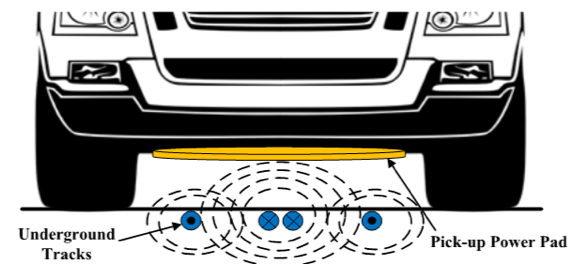
It will be implemented on highways (dynamic or in-motion wireless charging) giving an unlimited range for EVs without plugging-in or stopping for recharging. This technology will revolutionize future transportation systems. It will reduce the size, weight, and cost of the battery, which is the most expensive part in an electrical vehicle. The Nissan Leaf belonging to EPS is used for practical testing of this project.
Figure 1: Dynamic wireless charging – Future of Battery
Publications (13)
- Novel LCC-CLC Compensation Network Topology for Reducing Output Voltage Fluctuations in Dynamic Wireless Power Transfer (2026)
- Backstepping-Based Phase-Shift Control for Mitigating Voltage Variation in Dynamic Wireless Charging (2025)
- Passivity-Based Integral Terminal Sliding Mode Control for Suppressing Output Voltage Fluctuations in Dynamic Wireless Charging (2025)
- Suppressing Voltage Fluctuations With Optimized Assisted Coils in Dynamic Wireless Power Transfer (2025)
- Lyapunov Function-Based Control Strategy for Suppressing Power Pulsations in Dynamic Wireless Charging of Electric Vehicles (2024)
- Composite Second-Order Sliding Mode and Backstepping Control for Power Pulsation Suppression in Dynamic Wireless Charging (2024)
- Comprehensive review on power pulsation in dynamic wireless charging of electric vehicles (2024)
- Vehicle Position Detection Based on Machine Learning Algorithms in Dynamic Wireless Charging (2024)
- Novel control method with five-phase interleaved boost converter to reduce power pulsation in dynamic charging of electric vehicle (2023)
- Particle swarm optimization-based pid controller for stabilizing power in dynamic charging of electric vehicles (2023)
- Novel combined inductive and capacitive wireless power transfer system to reduce power pulsation for dynamic charging of electric vehicles (2023)
- Optimal design of IPT bipolar power pad for roadway-powered EV charging systems (2021)
- Finite element-based design optimization of magnetic structures for roadway inductive power transfer systems, (2016)